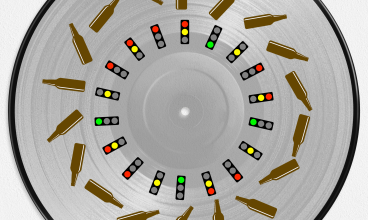
Vinyl records are one of the oldest forms of physical music with earlier versions dating back to the late 1800’s. However it was Peter Goldmark who invented the most common version of the vinyl record that is listened to by millions today. This 12 inch PVC disc was invented to have music pressed onto the wax with the intentions of listening with a needle and a turntable running at a speed of just over 33 revolutions per minute. This form of record that Goldmark invented was made of polyvinyl chloride which would have the sound waves pressed into the microscopic grooves which a special needle (usually made of sapphire or diamond) would pick up and pass them along towards to output. This new method gave more value to vinyl records and allowed more music to be featured. “Full frequency. There’s a reason records sound better. There is simply more on them”(Henry Rollins, 2018).

When viewing this invention with the naked eye, you are able to identify simple grooves that revolve around the record. However it is not until you view the same object with apparatus such as a microscope, that you start to see each individual engraving that the needle vibrates against. This adds a further layer of depth and as Edward Tufte states, “provides a credible refuge where the pace of visualization is condensed, slowed, and personalized” (Tufte, 1990). This further reinforces the concept of micro and macro working in conjunction to create an overall complete subject, as without the minuscule sound grooves, the larger polyvinyl disc would be futile. Based of these aspects, it is fair to conclude that without the advancement in the micro technology used to embed these sound waves, there would be no widespread using of vinyl records on a macro level.
Tufte, E (1990) Envisioning Information, P. 38
Longlivevinyl.net. (2018). Henry Rollins interview – Why Vinyl Matters. [online] Available at: https://longlivevinyl.net/2018/03/19/henry-rollins-interview-why-vinyl-matters/ [Accessed 6 Nov. 2021].
Mihai Andrei (2014). Watch a vinyl and stylus at 1000x magnification. [online] ZME Science. Available at: https://www.zmescience.com/other/great-pics/watch-a-vinyl-and-stylus-at-1000x-magnification/ [Accessed 6 Nov. 2021].